Indigenous Career Opportunities

Learn about career opportunities that support Indigenous patients and their families.

​​​​​​​​​​​​​​​​​​​​​​​​​​​​​​​​​​​​​

Indigenous patient navigators
BCCPG_BRENT_J_IPN_A7404203.jpg

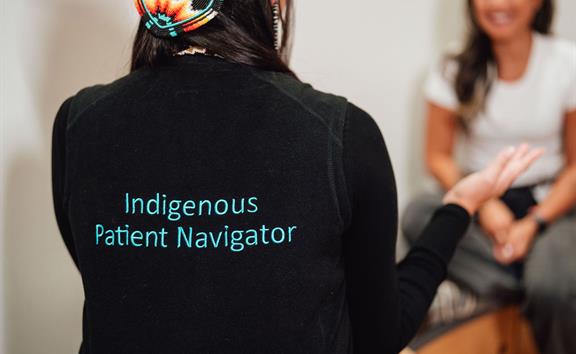
Indigenous patient navigators at BC Cancer play an important role in supporting Indigenous patients and their families throughout their cancer journey.

​What you'll do

As an Indigenous patient navigator, you will:
  • Connect patients with supports and resources offered by community and regional health organizations
  • Work with Indigenous communities and organizations to improve access to appropriate care
  • Partner with the cancer care team to provide supportive, trauma-informed and culturally safe care for Indigenous patients and their families
This rewarding role allows you to make a meaningful difference in the lives of patients and families. It requires strong communication, relationship-building and problem-solving skills.

These services are available to patients who identify as Indigenous, including First Nations (Status and Non-status), Métis, and Inuit.​​​

Indigenous Careers.png

​​​Education

You will need education, training and experience equivalent to a diploma or degree in a related health discipline, health or social sciences, or a patient care or clinical field​.

We highly value and prioritize lived experience and expertise as an Indigenous person.

The information below is not a complete list of programs or schools. It is intended as a starting point for exploring this career path.

​​​​​​​​​​​​​​​​​​​​

Qualifications

  • Lived experience as an Indigenous person (First Nations, Métis, or Inuit) in Canada is valued​
  • Knowledge of and experience working with Indigenous communities and organizations
  • Strong understanding of Indigenous peoples’ demographics, languages, cultures, customs and traditions
  • Knowledge of the health care system and community-based resources in the region
  • Understanding of cultural safety, anti-racism practices, Canadian colonization, Indigenous-specific racism, and their impacts on the health and wellness of Indigenous peoples
  • Strong verbal and written communication skills
  • Ability to work effectively as part of a multidisciplinary team
  • Ability to use sound professional judgment, empathy, compassion and integrity
  • Ability to prioritize work, maintain accurate records, and prepare reports
  • Ability to adapt as the Indigenous care program evolves
  • Ability to work independently, manage time effectively, meet deadlines, and achieve goals

Relevant degrees

  • Bachelor of Health Sciences (4 years)
  • Bachelor of Public Health (4 years)
  • Bachelor of Social Work (4 years)​

Education programs in British Columbia for Indigenous patient navigators

  • British Columbia Institute of Technology (BCIT)
  • Kwantlen Polytechnic University
  • Simon Fraser University (SFU)
  • Thompson Rivers University (TRU)
  • University of British Columbia (UBC)
  • University of Northern British Columbia (UNBC)
  • University of Victoria (UVic)

Interested in learning more about education requirements and available programs for Indigenous patient navigator careers? See our Student Education Pathways document.
Read the Student Education Pathways booklet
​​
Indigenous health promotion specialists

​Join BC Cancer as an Indigenous health promotion specialist and help improve cancer care and outcomes for Indigenous peoples across British Columbia.

What you'll do

In this role, you will:

  • Support culturally safe and equitable cancer control initiatives
  • Build strong relationships with Indigenous communities
  • Advance health promotion strategies that reflect Indigenous knowledge and practices

This role supports BC Cancer’s commitment to Truth and Reconciliation. You will work with Indigenous communities and health care teams to develop programs focused on cancer prevention, education and care. Your work will help ensure Indigenous peoples receive equitable, compassionate and effective cancer care services.

​Education

You will need education, training and experience equivalent to a bachelor's degree in a related field.

We highly value and prioritize lived experience and expertise as an Indigenous person.

The information below is not a complete list of programs or schools. It is intended as a starting point for exploring this career path.

Qualifications

  • Education, training and experience equivalent to a bachelor's degree in a related field
  • Five years of recent related experience working with Indigenous communities in public health, health promotion, education, community development, or capacity building
  • Lived experience with patient population is valued

You will also have:

  • Strong presentation, facilitation, collaboration and communication skills
  • Ability to work professionally and maintain confidentiality
  • Ability to build and maintain partnerships through collaboration, relationship-building and networking
  • Knowledge of cancer prevention and the health care environment 
  • Ability to work independently, take initiative and work with minimal supervision
  • Advanced skills in word processing, spreadsheets, databases, internet-based tools, and presentation software
  • Strong problem-solving skills and a proactive, creative approach
  • Strong organizational and interpersonal skills, with the ability to manage multiple priorities and meet deadlines

Relevant degrees

  • Bachelor of Health Sciences (4 years)
  • Bachelor of Public Health (4 years)
  • Bachelor of Social Work (4 years)
  • Bachelor of Administration or Marketing (4 years)​

Education programs in British Columbia for Indigenous health promotion specialists


  • British Columbia Institute of Technology (BCIT)
  • Camosun College
  • Capilano University 
  • Kwantlen Polytechnic University
  • Simon Fraser University (SFU)
  • Thompson Rivers University (TRU)
  • University of British Columbia (UBC)
  • University of Northern British Columbia (UNBC)
  • University of Victoria (UVic)​
​​​​​​​​​

Other career opportunities

BC Cancer offers many career opportunities where you can build a rewarding career and make a difference for people across British Columbia.

Explore these featured career paths: 

Interested in learning how to get started in one of these careers? Find information about education requirements in our Student Education Pathways document.
Read the Student Education Pathways booklet​
Tab Heading