Research
Oncology studies
Leads: Dr. Julianna Caon, Jacob Lemire
About the study: People with head and neck cancer are at high risk of malnutrition because of treatment side effects and metabolic changes. Malnutrition can negatively affect treatment outcomes and quality of life. Registered dietitians often face challenges when assessing body composition changes using standard methods, which can limit their ability to provide individualized nutrition care. This study explores changes in body composition and the gut microbiome during active treatment. The goal is to support more precise, personalized nutrition care at BC Cancer Victoria.
Questions? Contact Jacob Lemire (clinical coordinator of nutrition, BC Cancer Victoria) at jacob.lemire1@bccancer.bc.ca.
Leads: Eleah Stringer, Dr. Jonathan Livergant, Dr. Sally Smith
About the study: People with head and neck cancer may have difficulty finding clear, easy-to-understand information to help them make informed treatment decisions. This challenge can be greater for people with different levels of health literacy. Limited access to information can reduce patient engagement and affect care quality. The HANC App is being developed and tested as a patient-informed digital tool to improve access to cancer information and support informed, patient-centred care.
Questions? Contact Eleah Stringer (research lead) at
eleah.stringer@bccancer.bc.ca.
Leads: Katie Tsoupakis, Eleah Stringer
About the study: Patients with head and neck cancer often require enteral feeding during treatment, yet the timing, frequency, and communication around feeding tube use can vary, leaving patients feeling uncertain and overwhelmed. Understanding current practices and patient experiences is critical to improving nutrition care and supporting informed decision-making. This study addresses these gaps by examining feeding tube use at BC Cancer and exploring patient preferences for how information about feeding tubes is delivered.
Please send any questions to Eleah Stringer (Research Lead) at eleah.stringer@bccancer.bc.ca.
Leads: Dr. John Paul McGhie, Jacob Lemire
About the study: People with pancreatic cancer often develop pancreatic exocrine insufficiency (PEI). PEI can cause malabsorptive symptoms that increase nutritional risk and are linked to poorer survival, treatment response, and quality of life. Pancreatic enzyme replacement therapy (PERT) can help manage these symptoms, but it is often under-prescribed or under-dosed. Research suggests that involvement from a registered dietitian improves PERT use. This study will evaluate whether clinician-guided assessments using the BC Cancer PERT Tool align with pancreatic elastase-1 stool testing when identifying PEI in patients with inoperable pancreatic cancer and those receiving neoadjuvant chemotherapy at BC Cancer - Victoria.
Intermittent fasting research
Leads: Eleah Stringer, Dr. Nicol Macpherson, Dr. Julian Lum
About the study: Over several decades, increased food consumption has contributed to rising rates of many diseases, including cancer. Researchers are studying how nutrition and eating patterns affect people with cancer and whether changes in eating patterns may help prevent or manage cancer.
About the study: This study tested intermittent fasting in patients with chronic lymphocytic leukemia (CLL) and small lymphocytic lymphoma (SLL). Participants limited eating to an eight‑hour window six days a week for several months. Researchers collected blood, stool, and survey data to explore whether fasting affected tumour activity, metabolism, and autophagy. They also measured how long any biochemical changes lasted after fasting ended. The study took advantage of the fact that doctors can easily measure how much CLL/SLL cancer is present by counting lymphocytes in the blood.
Sponsors: The Grewal family and the BC Cancer Foundation.
Status: Completed in October 2022 (view pre-print of results).
Questions? Contact Eleah Stringer (research lead) at
eleah.stringer@bccancer.bc.ca.
About the study: Researchers are studying intermittent fasting as a potential way to slow cancer growth by triggering autophagy. This study compares two fasting schedules using 16‑hour fasting and 8‑hour eating windows. Researchers will examine effects on tumour activity, inflammation, autophagy markers, and gut‑derived metabolites while also assessing patient preferences.
Sponsorship: BC Cancer Foundation.
Status: Began in fall 2022.
Questions? Contact Eleah Stringer (research lead) at
eleah.stringer@bccancer.bc.ca.
About the study: Intermittent fasting may offer health benefits, but there have been few large studies in people with cancer. Patient adherence data are also limited. This study will provide stronger evidence about the effects of intermittent fasting on clinical outcomes, autophagy biomarkers, quality of life, and the gut microbiome. The study will also examine patient experience and include sex- and gender-based considerations.
Sponsors: BC Cancer Foundation; Lum Lab; Michael Smith Health Research BC Health Professional-Investigator Award; and the Lotte & John Hecht Memorial Foundation.
Status: Began in 2025.
If you have CLL/SLL, are not receiving anti-cancer treatment, live in British Columbia, and would like an update when recruitment opens, contact Eleah Stringer (principal investigator) at
eleah.stringer@bccancer.bc.ca.
Other research
Lead: Lindsay Van der Meer.
About the study: This BC Cancer Foundation-funded role was created to strengthen BC Cancer's ability to provide evidence-based nutrition care for patients and families. The three-year pilot demonstrated significant improvements in knowledge mobilization and innovation related to nutrition in cancer care.
Questions? Contact Lindsay Van der Meer (project lead) at
Lindsay.VanderMeer@bccancer.bc.ca.
Leads: Evelyn Wu, Chrissie Ohlund, Andrea Holmes, Eleah Stringer
About the study: People with head and neck cancer are at high nutritional risk because of treatment side effects and disease-related factors. These challenges often lead to unintentional weight and muscle loss, which can affect treatment tolerance and recovery. Standard care that relies only on body weight may not fully capture these changes, and some patients may view weight loss as beneficial. This study explores whether providing detailed body composition results through bioimpedance analysis (BIA) improves patient understanding and nutrition outcomes compared with weight measurement alone.
Questions? Contact Evelyn Wu (research lead) at
evwu@bccancer.bc.ca.
Leads: Eleah Stringer, Lindsay Van der Meer
About the study: People living in rural and remote communities may face greater barriers related to the social determinants of health, including access to health care services. This project examined whether distance from a BC Cancer centre was associated with malnutrition risk among people receiving palliative radiation therapy for gastrointestinal or breast cancer.
Publication: Van der Meer, L., Cender, S., Sappal, S., & Stringer, E. (2026). Malnutrition risk among people receiving palliative radiation therapy at BC Cancer: A geographical analysis. Canadian Journal of Dietetic Practice and Research, 87(2), 53–58. https://doi.org/10.3148/cjdpr-2025-030
Lead: Eleah Stringer
About the study: Developed in partnership with the Island Prostate Centre, this pilot project examined the feasibility of providing sustainable, evidence-based group nutrition education for people with prostate cancer on Vancouver Island. The study was open to all men diagnosed with prostate cancer. The goal was to integrate nutrition education at diagnosis, during treatment, and after treatment phase to support better outcomes and survivorship.
Publication: Stringer, E. J., Sidhu, S., Austin, K., & Cosby, C. (2021). Nutrition education seminars for prostate cancer: Diet and Prostate Program Evaluation and Recommendations (DAPPER Study). Canadian Journal of Dietetic Practice and Research, 82(1), 27–31. https://doi.org/10.3148/cjdpr-2020-028
- Chronic lymphocytic leukemia
- Dietary patterns
- Autophagy
- Metabolomics
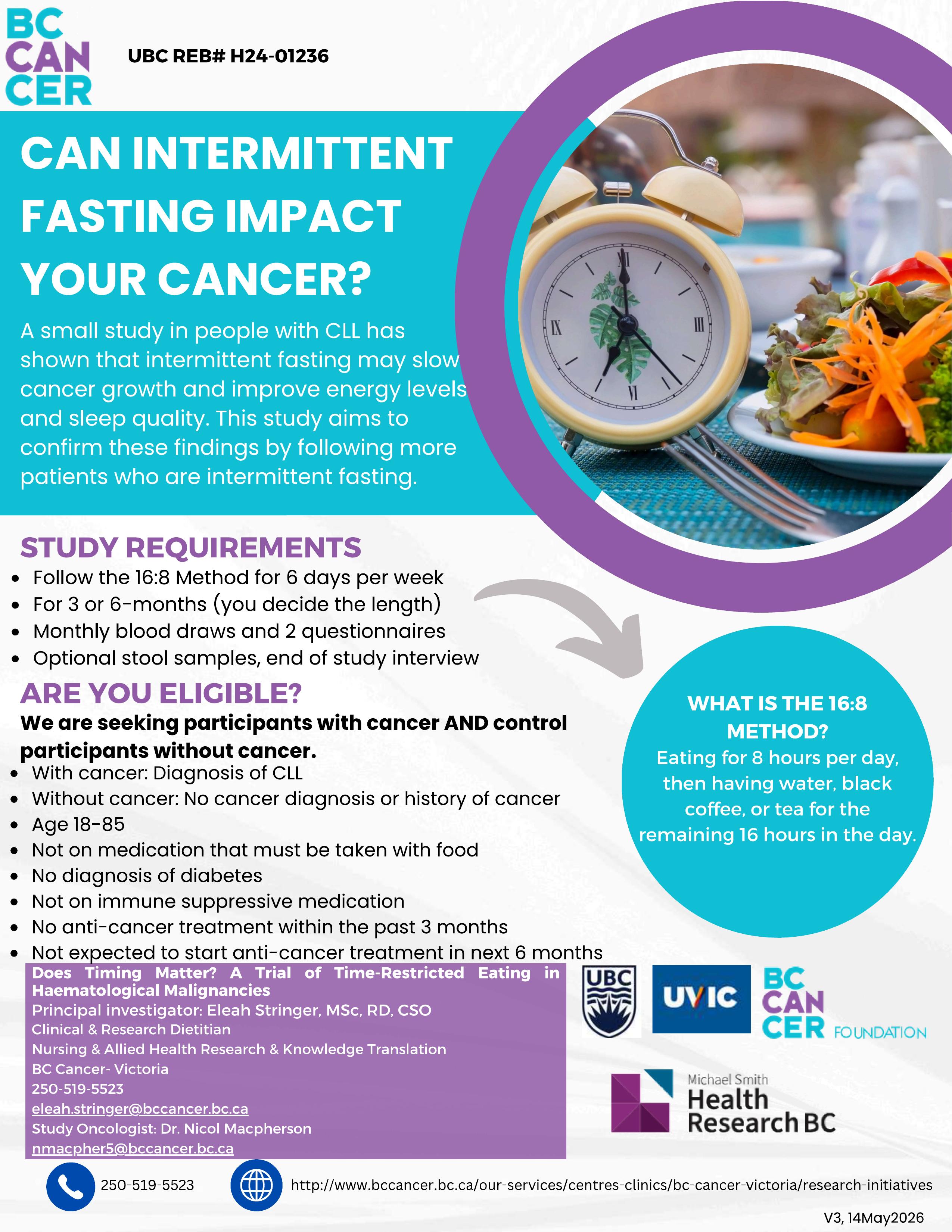
Our early research suggests that intermittent fasting may slow cancer growth at the cellular level. We are recruiting healthy volunteers and people with hematological (blood) cancers who are willing to limit their eating to an eight-hour window each day for three or six months.
The study will investigate whether time-restricted eating affects tumour growth, cellular process, and quality of life.
- Follow a 16:8 time-restricted eating schedule (eating within an 8-hour window) six days per week
- Choose a participation period of three or six months
- Complete a quality of life questionnaire at the beginning and end of the study
- Have monthly bloodwork at LifeLabs
- Track eating times throughout the study
- Receive weekly check-ins during the first month and bi-weekly check-ins afterward
Participants may also choose to provide stool samples and complete an end-of-study interview.
Healthy volunteers will not provide stool samples or complete questionnaires. They will only participate in first-month check-ins.
- Age 18 to 85 years
- Healthy volunteers accepted
British Columbia
March 31, 2026
Principal investigator: Eleah Stringer
Health authority: Provincial Health Services Authority
Academic affiliations: University of British Columbia (Vancouver), University of Victoria
Collaborating organizations: Stefanska Lab (University of British Columbia), Deeley Research Centre, BC Cancer
Please visit
Reach BC for more information about this study.