When you pass by a construction site, you likely don't give much thought to what goes into a concrete pour. But at the new BC Cancer centres in
Nanaimo,
Kamloops and
Surrey, these pours represent something far more significant.
Construction is well underway with major progress with the concrete pour for the linear accelerator (LINAC) vaults, which are specialized rooms designed to house the machines that will deliver life-saving radiation therapy to thousands of patients each year.
The Nanaimo centre will have four LINACs, Kamloops will have three LINACs and the new Surrey hospital and BC Cancer Centre will have room for six LINACs to deliver radiation treatment. The new centres in Nanaimo and Kamloops are set to open 2028 and Surrey in 2030.
A linear accelerator, commonly called a LINAC, is the most widely used machine for delivering external radiation therapy. It produces high-energy X-rays that are carefully targeted at cancer cells while minimizing exposure to surrounding healthy tissue.
These machines are precise and powerful, which means the rooms that house them must be specially designed and built.
Unlike a standard hospital room, a LINAC treatment room must safely contain radiation during treatments. The walls, floor and ceiling need to provide extensive shielding to protect patients, staff and visitors in nearby areas.
Long before any concrete arrives on site, BC Cancer and host health authority subject matter experts, architects, engineers, and project managers work together to finalize the design.
“The LINAC concrete pours in Nanaimo, Kamloops and Surrey reflect the collaboration and expertise required to build spaces that will meet the need for radiation treatment well into the future," said Robin Latondresse, senior executive director, Major Capital Projects, Provincial Health Services Authority. “By designing these spaces to support radiation treatment, we are helping ensure that the new centres are ready to meet evolving care needs for generations to come."
Every detail is carefully planned, from the placement of steel reinforcement to the exact dimensions of the walls. Detailed plans are reviewed and verified, specialized formwork is constructed, and large amounts of reinforcing steel are installed throughout the structure.
The photos below show the LINAC vaults taking shape and the future radiation treatment suites they will become.
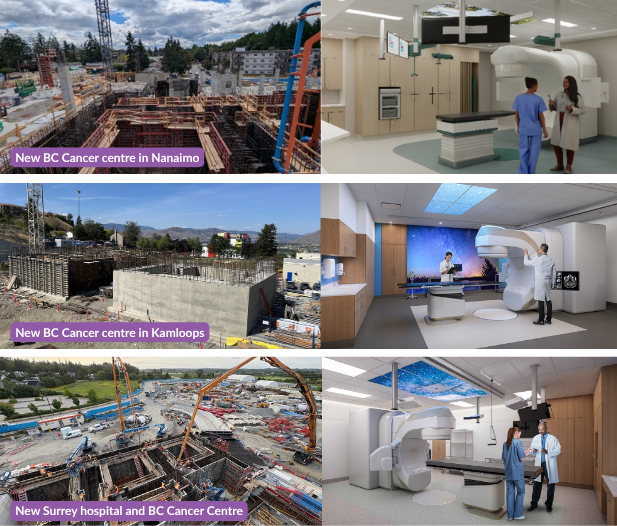
Because of the size and complexity of the treatment vault, the pour involves hundreds of cubic metres of concrete delivered continuously over many hours.
The scale of the LINAC vaults is reflected in the amount of concrete required:
- Nanaimo: 1619 m³
- Kamloops: 1,350 m³
- Surrey: Approximately 2,200 m³
Once the pour is complete, the concrete needs time to harden before the next stage of construction can begin.
Although the concrete itself will eventually be hidden behind finished walls and equipment, it forms one of the most important parts of the new cancer centres.
“Expanding access to radiation therapy closer to home is an important step toward improving cancer care across BC," said Cherie Taylor, executive director, Clinical Operations & Capital Redevelopment, BC Cancer. “The LINACs will support high-quality care closer to home, reducing travel and helping more patients get timely treatment for years to come."
Learn more about our new BC Cancer centres on our
Projects and Priorities page.